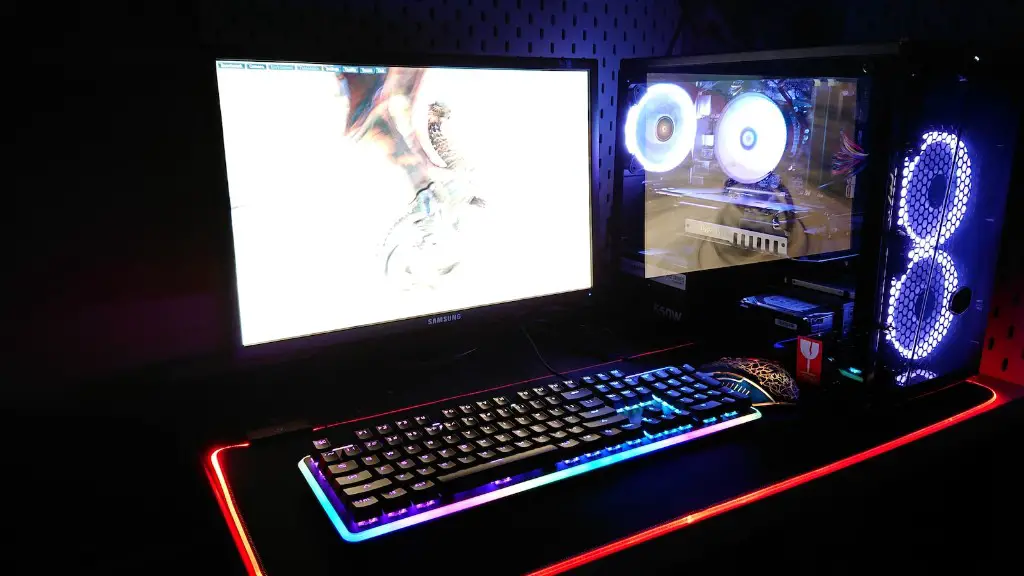
Building a custom gaming PC can be daunting, but understanding the various components that make it up is the key to success. Firstly, the foundation of any gaming PC is the motherboard. This serves as the hub for the other components, allowing them to talk to one another and be powered. Secondly, a good processor must be chosen to run games efficiently. A higher end processor will boost in-game performance by crunching more numbers per second. GPU follows from the processor and is one of the most important components of any gaming PC. It helps determine the frames per second you’re able to achieve in-game, and therefore plays an important role in gaming performance. All this is useless if you don’t have the correct RAM to match. It helps the processor and GPU access data quickly in order to provide a better experience. Fourthly, storage is needed to store your games on. A Solid State Drive (SSD) can prove immensely beneficial due to the lightning-fast speeds they provide and the ability to virtually eliminate loading times when gaming. Fifthly, the Power Supply Unit (PSU) powers your PC. The right PSU will allow you to use the right kind of components that require more power. Finally, the best gaming PCs require a good-quality case. A gaming case will ensure that the PC has enough airflow to keep the hardware cool and runs as efficiently as possible.
Motherboard
A motherboard is one of the most important components of any gaming PC, serving as the primary connection between the other parts. It contains ports and slots for memory, video cards, hard disks, and more. It also houses the BIOS, the basic instruction set that the computer uses to start up. It is important to select a motherboard that is designed for gaming as it will include features that are beneficial for gaming such as extra ports and more slots for faster performance.
Processor
A processor is the central processing unit (CPU) of the gaming PC. It’s responsible for handling the instructions fed to it by the software and performing calculations on the data provided. This makes it integral to the performance of the gaming PC. When selecting a processor, it is important to choose one that matches the needs of the PC, as a high-end processor will provide more performance than a low-end one.
GPU
A Graphics Processing Unit (GPU) is one of the most crucial components when selecting a gaming PC. It determines the frames per second (FPS) that the game will run at, and is essential for an enjoyable gaming experience. It determines how well the game looks, how quickly it runs, and how responsive it is to user input. When selecting a GPU, it is important to select one that can handle the most intense games, as this will ensure the best gaming experience.
RAM
Random Access Memory (RAM) ensures that the processor and GPU can access data effectively, without having to wait for it to be loaded from the hard drive. It is an important part of gaming PCs as it is used to store textures and data in order to reduce load times. When selecting RAM, it is important to select memory that is fast enough to keep up with the GPU and processor, as well as being reliable.
Storage
Storage is used to store games and applications on the computer, and the type of storage used will determine the performance of the computer. Most gaming PCs now use an SSD as the main form of storage, as these offer lightning-fast speeds and virtually eliminates loading times. It is also important to select a form of storage that is large enough to store the games and applications you wish to play, as this will ensure that you always have access too them.
Power Supply Unit
A Power Supply Unit (PSU) supplies power to the gaming PC and helps ensure that the hardware runs as efficiently as possible. It is important to choose a PSU that can handle all the components that the PC requires, as different components require different amounts of power. A higher end PSU will provide a more efficient performance, as it is able to provide the right level of power when needed.
Case
Finally, the case is the outer shell of the gaming PC and provides support for the other components. It is responsible for providing the necessary airflow to keep the components cool and to ensure that the PC runs as efficiently as possible. A case with good design and excellent cooling can help improve the overall performance of the PC and make it more enjoyable to use.
