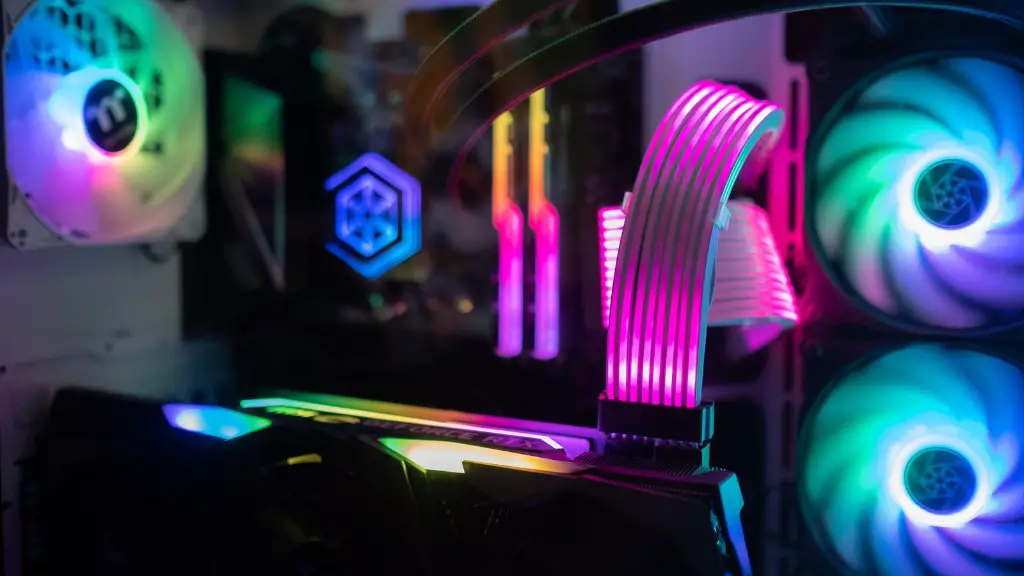
Can you code on a gaming PC? It is possible, and with the right setup, the gaming experience and performance can be of the highest calibre. Here, we take a look at what to consider before coding on a gaming PC.
First, it is essential to choose a robust processor to match the amount of computing power required to code efficiently. An Intel i9 or AMD Ryzen 9 processor would be recommended, ensuring that the machine is capable of handing multitasking duties with ease. Additionally, it is advisable to purchase DDR4 RAM, as this type of memory is optimal for both gaming and coding.
Another important feature for both gaming and coding is a high-end graphics card, such as one from Nvidia or AMD. The graphics card is responsible for intensive tasks such as rendering 3D environments or crunching through vast arrays of data. The performance of the graphics card can be further enhanced by powering the machine with a good quality power supply.
It is also recommended to purchase a monitor that is suited for both coding and gaming, with a large screen and high pixel resolution. Not only will this make the coding process easier, but it will also enhance the gaming experience, due to the clearer visuals and faster response time. Additionally, a large and roomy hard drive, such as a solid-state drive (SSD) will ensure enough space to store multiple applications and libraries in an efficient manner.
Finally, it is necessary to ensure that the other components, such as the motherboard, sound card, and network cards, are all up to the task. As these elements tend to be used more frequently by gamers, it is crucial to check their specifications and compatibility. Many models come in packages that not only include these components but also specialised cooling systems, which are important for gaming PCs, to prevent them from overheating.
What Type Of Software Can Run On A Gaming Pc?
Software developers tend to require specific tools to do their jobs efficiently, and there are several software packages available that are designed specifically for coding. Popular choices include IDEs such as Visual Studio, Visual Studio Code, and Eclipse, as well as language-specific tools such as RubyMine, Java Development Kit, and Turbo C++. Moreover, many extensions are available for software libraries such as the Microsoft .NET Framework and Unreal Engine to allow for further customisation.
In addition, scripting engines such as Python and scripting languages such as JavaScript can also be used with ease on a gaming PC, allowing for code to be deployed quickly and efficiently. It is advisable to use specialised applications for different tasks, such as GitHub for version control and Atom for website creation.
Moreover, servers such as Apache and Nginx are great for hosting websites. And the powerful computing power of a modern gaming PC doesn’t skimp on creativity either, as coding tools such as Unity 3D, Adobe Photoshop, and Video Editing Software can also be used with ease. All of these tools and more can be found on the popular gaming platform, Steam.
Does A Gaming Pc Need Special Setup?
It is important to ensure that the gaming PC is configured correctly to allow for coding tasks to be done efficiently. A first step would be to download and install the latest Drivers, since outdated Drivers can adversely affect performance. It is also important to execute Windows Updates to ensure that the system is well protected against security vulnerabilities.
After setting up the system, setting aside some power management options can help keep the PC running cool and quiet. Thermal monitoring applications such as SpeedFan can be used to actively monitor system temperatures, allowing for optimal performance and preventing the system from crashing.
Adequate fan management is also necessary for a gaming PC as fans have an impact on the machine’s overall performance. Fan control applications such as SpeedFan are beneficial for manually adjusting fan speeds, although some motherboards offer the ability to control fan settings automatically.
Finally, it is important to secure the system from potential threats. Firewall protection can be added by activating Windows’ built-in Firewall software, while antivirus software provides an extra layer of security.
Do Gaming Pcs Perform Better For Coding?
The type of performance a gaming PC can offer is dependent on the quality of components and, in some cases, the type of game being played. While there is no definitive answer as to which setup fares better for coding, it cannot be denied that gaming PCs are more powerful and capable in dealing with higher intensity tasks, such as rendering. Additionally, gaming PCs offer more space and RAM to run multiple applications simultaneously and have a certain amount of flexibility when it comes to tinkering and tweaking with settings.
Having said that, there are some tasks that require more rigorous processing, such as video encoding, 3D modelling, or natural language processing. These tasks typically require a more powerful rig, such as one featuring a high-end graphics card or a specialized AI accelerator. Additionally, the overclocking potential of some gaming PCs can be another great benefit for certain coding tasks.
Can Budget Gaming Pcs Code?
Budget gaming PCs can also be used for coding purposes, although the performance may not be as great as a higher-end system. In many cases, such a setup may struggle with more intensive tasks, such as 3D modelling or improving AI algorithms. However, these setups can still provide general coding activities with ease and may be a great option for those on a tight budget.

It is worth noting that budget gaming PCs typically have limited hardware choices, meaning that the components may have to be upgraded in order to gain a better performance gain. Additionally, the RAM and storage of some budget systems may be too small to handle heavy multitasking tasks. It is useful to consider these factors when deciding upon a budget gaming PC.
What Are The Pros And Cons Of Coding On A Gaming Pc?
Overall, coding on a gaming PC presents both advantages and drawbacks. One of the major benefits of using a gaming PC can be in terms of ease of use, as the interface and experience are often very similar to what is found on a gaming platform. Additionally, with the right setup and components, coding processes may be quicker, with greater efficiency.
Another great plus of gaming PCs is their flexibility and overclocking potential, allowing for the components of the machine to be tweaked in a variety of different ways. This can be especially beneficial for tasks such as video encoding and 3D rendering. Additionally, some gaming PCs may offer additional features, including lighting and noise control.
On the other hand, there are also drawbacks to consider. In many cases, gaming PCs can be quite pricey, depending on the specifications. Also, setting up a gaming PC for coding can be quite tricky and requires knowledge concerning compatibility options. Finally, coding on a gaming PC may not be as efficient as running dedicated coding tools on a machine that has been specifically designed for coding purposes.