Is Gaming Monitor Better Than TV?
Nowadays, gaming has become one of the most popular leisure activities, with games becoming increasingly sophisticated and appealing. As such, many people have been asking if gaming monitors are better than TVs. The answer is yes, provided that a few conditions are met.
To begin with, a gaming monitor must have a high refresh rate, usually ranging from 144Hz to 240Hz. This allows for smoother rendering and more precise pixel control. Furthermore, inputs are also a key factor, as gaming monitors must be equipped with multiple Input /Output ports to ensure compatibility with gaming consoles, PCs and even phones.
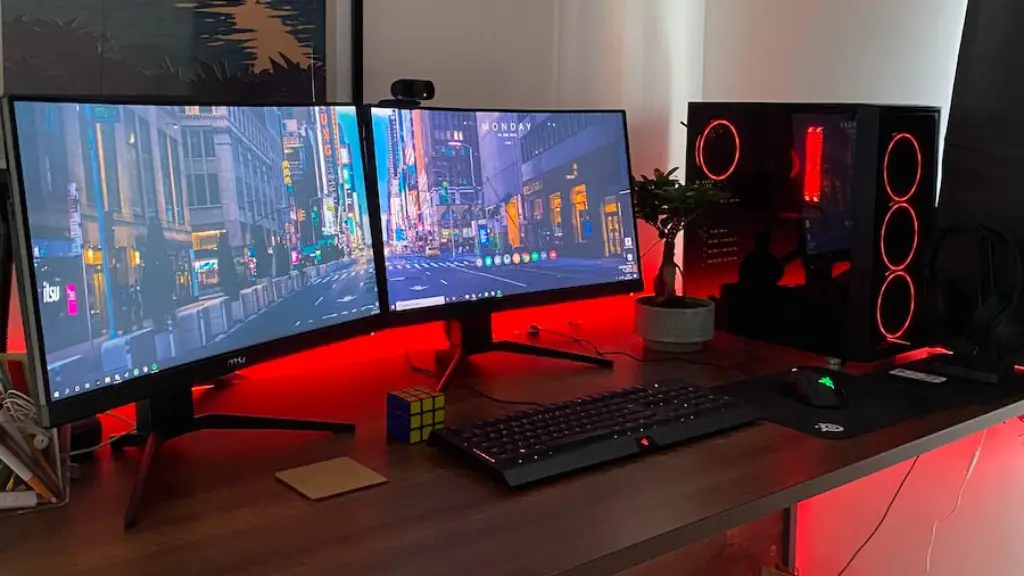
On the other hand, TVs cannot always keep up with fast moving gaming scenes. While a superior refresh rate means buttery smooth images, higher resolutions also mean sharper image quality and more vibrant colours. Moreover, TV’s contrast ratio is always lower than that of a gaming monitor’s, which gives gaming monitors a much larger color gamut range.
In addition, gaming monitors have other features to offer like G-Sync or FreeSync technology. This helps to minimize input lag, stutter and reduce artifacts, ultimately giving players a much better gaming experience. In contrast, TVs aren’t enabled with such technologies, which makes gaming monitors the preferred choice for gamers.
Finally, gaming monitors have also been designed to provide greater ergonomics. Not only do they come with adjustable stands, but many of them may also provide other options such as swivel, tilt and more, making it more comfortable and easier to adjust the viewing angle.
Dark Level Adaptation
An important aspect differentiating gaming monitors from TVs is the ability of gaming monitors to adapt to different levels of darkness in gaming scenes. This ensures that users are presented with the most realistic depiction of the game, making it feel more immersive and life-like. This is especially important to gamers looking for the most realistic gaming experience.

However, some TVs can also come with various technologies to enhance the image quality through brightness level adjustment and backlight dimming. But this does not match the capabilities of a gaming monitor, as a gaming monitor can continuously adjust the backlighting, as opposed to just dimming and brightening the entire screen. This helps to create dynamic local contrast, resulting in a more vibrant and sharper image.
Image Smoothing
The ability of a gaming monitor to display images more smoothly than a TV is largely down to the number of frames per second and the refresh rate. With a higher frames per second and refresh rate, gamers are able to enjoy a smoother and more fluid gaming experience. This means that gamers are able to get a better response time and a more detailed image.
On the other hand, TVs are unable to keep up with the faster pace of gaming and therefore fail to provide the same level of image smoothing. TVs also have a limited refresh rate, which means that gamers won’t be able to experience the same level of graphics as they would with gaming monitors.
Design Customization
In addition to being more responsive, gaming monitors also offer more design customization options than TVs. For example, gaming monitors often come with features such as adjustable bezels and customizable stands. This makes it easy for users to tailor the gaming experience to their own preference.

In comparison, most TVs offer only basic design options, such as the ability to tilt the screen. Furthermore, TVs may also limit the gamers’ ability to view the entire screen from any angle. This can significantly reduce the gaming experience, as a precise positioning of the game is often necessary for optimum performance.
Cost-Effectiveness
To gain a better gaming experience, gaming monitors are often more cost-effective than TVs. This is because gaming monitors are specifically designed to cater to the needs of gamers. Furthermore, gaming monitors tend to be equipped with a wide range of essential features, thus providing better value for money.
Additionally, gaming monitors come in a wide range of sizes and resolutions, allowing gamers to choose one that best suits their needs and budget. In comparison, TVs may be more expensive due to their larger size and higher resolution, resulting in a less cost-effective solution for gamers.
Responsiveness
When it comes to responsiveness, gaming monitors outclass TVs in almost every way. The majority of gaming monitors are equipped with low response time, thus ensuring that gamers receive immediate and accurate visual feedback. Moreover, gaming monitors also have variable backlight control, which helps to reduce motion blur.
Conversely, the majority of TVs come with slow response times, resulting in inaccurate visuals. This can cause problems such as input lag, which can significantly disrupt the gaming experience. Additionally, most TVs also come with a constant backlight, which can cause judder, making the image appear distorted or blurred.
Refresh Rate
Finally, a higher refresh rate makes gaming monitors significantly more appealing than TVs. The majority of gaming monitors come with a 144Hz refresh rate, while the majority of TVs only come with a 60Hz refresh rate. This makes gaming monitors the obvious choice when it comes to enjoying a smooth and seamless gaming experience.
Furthermore, certain gaming monitors also come with refresh rates up to 240Hz. This makes them ideal for competitive gaming, especially when chasing higher frame rates is a priority. In comparison, TVs cannot keep up with the fast-paced action of gaming, meaning gamers are always likely to come up short.
