When it comes to selecting a monitor for gaming, it can be difficult to know what to look for and make the best decision for your needs. Here are some tips to help you decide what features are important and how to choose the best gaming monitor for you.
First of all, size matters when it comes to gaming monitors. It’s important to pick a size that fits your desk space and won’t be too small or too large for the environment you plan on using the monitor in. It’s also important to look for monitor refresh rate, which can make a big difference in how smoothly games run. A refresh rate of at least 75Hz is recommended for gaming.
Next, consider the type of panel used in the monitor. Different panels have different advantages and disadvantages. TN panels have a fast response time, which is ideal for competitive gaming, while IPS panels have superior color accuracy and viewing angles. VA panels provide good contrast and color accuracy, and there are also different HDR options available.

The resolution of the monitor is also important, as higher resolutions offer a more detailed image and a more immersive gaming experience. Aim for a resolution of 1080p or higher if you’re looking for a good gaming experience. Also, some monitors come with extra features such as G-Sync or FreeSync, which can help reduce screen tearing and stuttering.
Finally, the type of connection matters. Many gaming monitors still use HDMI, but newer models are beginning to use DisplayPort or USB-C for higher performance. Be sure to check the connections available on any monitor you’re considering to ensure compatibility with your setup.
Types of Panels
It’s important to consider the type of panel being used in a gaming monitor. TN panels have the fastest response times, usually around 1ms, and are best for competitive gaming, while IPS panels provide superior color accuracy and viewing angles. VA panels provide good contrast, while they tend to be a bit slower than IPS panels. Additionally, there are also different HDR options, such as HDR10+ and Dolby Vision, available on some gaming monitors.
Each type of panel has its own advantages and disadvantages and it’s important to consider what type of gaming you plan on doing before selecting a panel. Fast-paced competitive games may benefit from a TN panel, while creative or open-world games may benefit from better viewing angles and color accuracy offered by an IPS panel.
HDR capable monitors offer peak brightness of up to 1000 nits and a wider color gamut for a more realistic gaming experience. However, it’s important to note that some HDR features require compatible games and graphics cards, so if you’re planning on taking advantage of this feature, make sure both your monitor and game support the necessary technology.
Overall, considering the type of panel your gaming monitor uses is important to ensure you get the most out of your gaming experience.
Refresh Rates
Another important aspect to consider when choosing a gaming monitor is the refresh rate, which is usually expressed as Hertz. Refresh rate measures how often the monitor’s image is refreshed, which can have a big impact on how smoothly games run. A higher refresh rate will lead to a smoother experience, with fewer stutters and frame rate drops, while a lower refresh rate will result in a choppier image.
The most commonly available refresh rates are 60Hz, 144Hz, and even up to 240Hz on some models. A 60Hz monitor is usually adequate for casual gaming, while 144Hz and 240Hz offer more smoother gaming experiences. If you’re planning on using the monitor for competitive gaming, then a higher refresh rate Monitor such as 144Hz or 240Hz is recommended.
Some gaming monitors also offer variable refresh rate technologies such as G-Sync or FreeSync, which can help reduce screen tearing and stuttering. These technologies can be useful if you’re using a graphics card that isn’t capable of keeping up with your monitor’s refresh rate.
Overall, refresh rate is an important factor to consider when selecting a gaming monitor and it is important to choose one that best meets your needs.
Resolution
When selecting a gaming monitor, it’s also important to consider the resolution. Resolution is usually expressed as a number of pixels, with HD resolution being 1920 x 1080 pixels, and 4K resolution being 3840 x 2160 pixels. Higher resolutions offer a more detailed image, which can lead to a more immersive gaming experience.
Ultra-wide monitors offer a different gaming experience, and can be an interesting option for certain types of games. These monitors offer a wider field of view and can be useful for open-world or creative games, but they may not be as suitable for competitive gaming.
In general, 1080p resolution is a good baseline for gaming, while 1440p resolution is also becoming increasingly popular as more games support it. If you plan on gaming competitively, then 1440p resolution may be a better option, as it offers better visuals without sacrificing too much performance. For the highest visual fidelity, you can also select a 4K capable monitor, although this will require a powerful graphics card.
No matter what resolution you choose, it’s important to make sure the games you plan on playing can run properly at that resolution.
Connections
Finally, the type of connection matters. Many gaming monitors still use HDMI for video signals, but newer models are beginning to use DisplayPort or USB-C for higher performance. Be sure to check the connections available on any monitor you’re considering to ensure compatibility with your setup.
Some monitors also offer additional ports such as audio jacks and USB ports, which can be useful for connecting gaming headsets or connecting controllers or other devices. It’s important to check the list of ports available on any monitor you’re considering to make sure you’re getting the most out of your gaming experience.
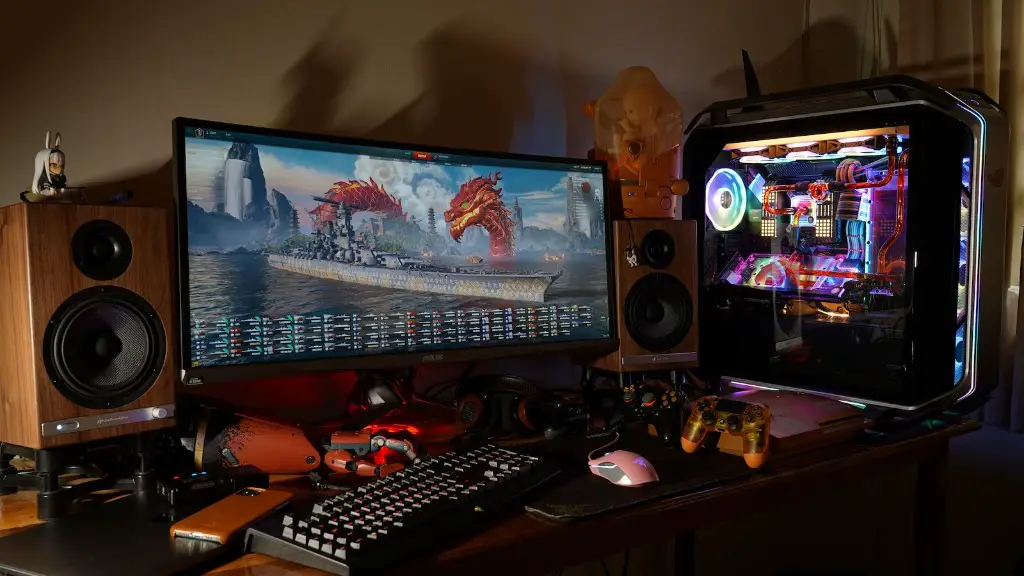
It’s also important to consider other features such as Adaptive Sync, which can help reduce the stuttering and screen tearing associated with gaming. Additionally, some monitors also come with extras such as integrated speakers, built-in RGB lighting, or even webcams.
Overall, it’s important to consider the type of connection and additional features available on any gaming monitor you’re considering and make sure they are compatible with your system.
